The construction industry is no stranger to transformation. From adopting Building Information Modeling (BIM) to embracing modular and prefabrication techniques, the shift toward digitization has been steady but significant. Now, a new revolution is underway – Artificial Intelligence (AI) and robotics are stepping into off-site fabrication, pushing speed, accuracy, and efficiency to unprecedented levels.
As off-site construction continues to dominate headlines for its ability to cut timelines and costs, the integration of AI and robotics is creating the next big leap forward. This blog examines how these technologies are reshaping steel fabrication and modular construction, their benefits, and what the future holds.
Why AI and Robotics Matter in Off-Site Construction
Off-site construction thrives on precision and predictability, two areas where human error or delays can lead to costly consequences. AI and robotics bring:
- Unmatched accuracy: Robotic arms and automated machines can achieve millimeter precision in cutting, drilling, and assembly.
- Data-driven decisions: AI algorithms analyze vast data sets from BIM models, project schedules, and material specs to optimize workflows.
- Consistent quality: Machines don’t fatigue, ensuring consistency across thousands of identical components.
The result? A smarter, faster, and safer off-site fabrication environment that minimizes waste, improves efficiency, and reduces costs.
How AI and Robotics Are Changing the Game
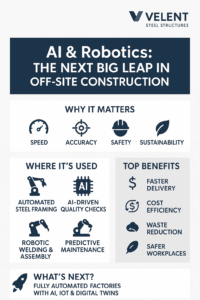
1. Automated Steel Framing
Cold-formed steel (CFS) framing is the backbone of many modern modular projects, and automation is taking it to the next level. AI-powered roll-forming machines now read data directly from BIM models, cutting and labeling each piece with flawless accuracy. Robots then handle assembly, ensuring every connection is precise and fast.
The result? Production cycles that once took days can now be completed in hours, with minimal material waste and virtually zero rework.
2. AI-Powered Quality Control
Gone are the days when quality checks relied solely on manual inspection. Today, advanced computer vision systems scan every fabricated component in real time, and AI algorithms instantly flag any dimensional errors, surface defects, or irregularities.
What does this mean for you? Near-100% quality assurance before the product ever leaves the factory floor, reducing the risk of costly site delays or replacements.
3. Robotic Welding and Assembly
Welding and repetitive assembly tasks are time-consuming, labor-intensive, and prone to human error. Robotic welding arms now execute complex joints with unmatched precision and consistency. These robots work around the clock without fatigue, producing uniform weld strength on every module.
The payoff? Faster turnaround times, improved safety for workers, and significantly reduced dependency on scarce skilled labor.
4. Predictive Maintenance and Workflow Optimization
AI isn’t just about manufacturing; it’s also transforming factory operations. Intelligent systems continuously monitor machines and predict maintenance needs before breakdowns occur. By analyzing performance data, AI also optimizes production workflows, identifying bottlenecks and recommending improvements.
The impact is huge: Less unplanned downtime, higher equipment uptime, and smoother, more efficient production runs.
Benefits for Developers, Fabricators, and Contractors
1. Faster Project Delivery
AI and robotics dramatically compress project schedules. While traditional fabrication may take weeks, automated production lines can roll out entire sets of components within hours. Faster output enables developers to meet tight deadlines, reduce holding costs, and bring projects to market more quickly.
2. Cost Efficiency
Labor shortages and escalating wages are global challenges. By automating high-volume, repetitive tasks, companies reduce dependency on manual labor, resulting in significant cost savings. Additionally, AI minimizes costly errors and rework, further driving profitability.
3. Sustainability and Waste Reduction
Automation ensures precision in cutting and assembly, which directly translates to lower material waste. When combined with steel’s 100% recyclability, AI-driven fabrication supports green building certifications like LEED and BREEAM, helping companies meet strict environmental regulations.
4. Enhanced Worker Safety
Construction sites remain one of the most hazardous workplaces. By transferring dangerous and repetitive tasks, such as welding, lifting, and drilling to robots, companies drastically lower the risk of injuries. This not only safeguards workers but also reduces insurance and compliance costs.
5. Consistent Quality and Standardization
Robotic processes operate with consistent calibration, eliminating variability that often comes with human labor. This guarantees high-quality outputs across multiple projects, making large-scale modular developments easier to manage and replicate.
Challenges to Overcome
1. High Initial Investment
Deploying AI systems and robotics requires substantial upfront capital. From purchasing automated machinery to integrating AI software and hiring specialists, the financial barrier can be steep. For small and mid-sized firms, this often means seeking strategic partnerships or phased adoption.
2. Workforce Reskilling
Automation does not eliminate the need for human expertise—it transforms it. Workers must be retrained to operate, maintain, and troubleshoot advanced machinery. Without effective upskilling programs, companies risk operational delays and reduced efficiency.
3. Integration with Existing Systems
AI and robotics deliver maximum value when seamlessly integrated with BIM, ERP, and other project management platforms. However, legacy systems in many organizations lack compatibility, creating data silos and operational bottlenecks.
4. Data Security and Privacy Concerns
AI systems rely on vast datasets, including design plans, schedules, and vendor details. This introduces cybersecurity risks, especially in large-scale projects involving multiple stakeholders. Robust data protection measures are essential to avoid breaches.
5. Regulatory and Compliance Hurdles
Building codes and labor regulations have yet to catch up fully with AI-driven processes. Navigating compliance in different jurisdictions can be challenging and time-consuming, potentially slowing adoption for global projects.
What’s Next?
Expect to see fully automated factories producing entire volumetric modules, integrated with IoT sensors for real-time tracking, and AI-driven logistics systems optimizing delivery routes. As governments enforce stricter sustainability codes and faster housing delivery timelines, AI and robotics will move from an option to an obligation.
Conclusion
The synergy of AI and robotics is not just upgrading off-site fabrication; it’s redefining it. For steel manufacturers, fabricators, and modular builders, early adoption is no longer a competitive advantage; it’s the key to survival in an industry where speed, precision, and sustainability rule.
Ready to take the next step? Contact our experts today and future-proof your construction workflows.