In an industry racing to meet the demands of rapid urbanization, skilled labor shortages, and net-zero building mandates, off-site construction has emerged as more than just a trend, it’s becoming the backbone of modern building strategies. But amid the buzzwords like modular and prefabrication, there’s still widespread confusion about what these terms truly mean and how they impact project timelines, costs, compliance, and sustainability.
This blog cuts through the noise. Whether you’re a developer, architect or contractor, understanding the clear distinction between modular and prefabricated construction is essential, not just for technical accuracy, but for smarter planning and greater ROI.
In 2025 and beyond, cold-formed steel (CFS) is taking center stage in off-site solutions. From high-speed manufacturing to precision BIM integration and superior environmental performance, CFS is reshaping the way we design and deliver buildings. Read on to explore the latest technologies, evolving compliance codes, and real-world project insights that prove why steel isn’t just strong, it’s the smartest choice in off-site construction today.
Why This Conversation Is Different in 2025
Off‑site construction has broken out of its “niche” label. According to Data Horizzon Research, Global revenue is forecast to climb from US$120 billion in 2024 to US$195 billion by 2033, with modular systems already commanding 45% of that spend and Asia–Pacific holding a 40% share. Developers routinely quote cost savings of 15–20% and program reductions of 25–30% when they move work into the factory.
Clearing Up the Terminology
| Term | What Happens in the Factory? | What Arrives on Site? | Typical Use‑Cases |
| Prefabrication (panelised) | Cold‑formed‑steel (CFS) frames, wall/roof panels, MEP cassettes | Flat packs for rapid stick‑build assembly | Mid‑rise apartments, hotels, data‑centre pods |
| Modular (volumetric) | Fully serviced 3D “rooms” with finishes, fixtures & services | Plug‑and‑play volumetric modules | Student housing, hospitals, single‑family homes |
| Off‑site | An umbrella term that includes prefab, modular, pods & hybrid approaches | — | Any project shifting labor off-site |
The traditional distinction still holds: prefabrication refers to individual components like panels and frames, while modular construction involves fully finished volumetric units. However, as of 2025, building codes and industry standards have now formally defined and standardized these categories, bringing much-needed clarity to off-site construction terminology.
The Compliance Landscape Has Shifted
- ICC/MBI 1200‑2021 & 1205‑2021: Now adopted by Montana, Virginia, Utah and the US GSA, giving AHJs a common playbook for design, inspection and transport.
- ICC/MBI 1210‑2023: New standard for factory‑installed MEP, energy efficiency and water conservation—critical when you’re integrating HVAC and fire services into steel modules.
- IBC 2024: Tighter envelopes, mandatory renewables in many occupancies and expanded fire‑resistant assemblies, all of which reward non‑combustible CFS framing.
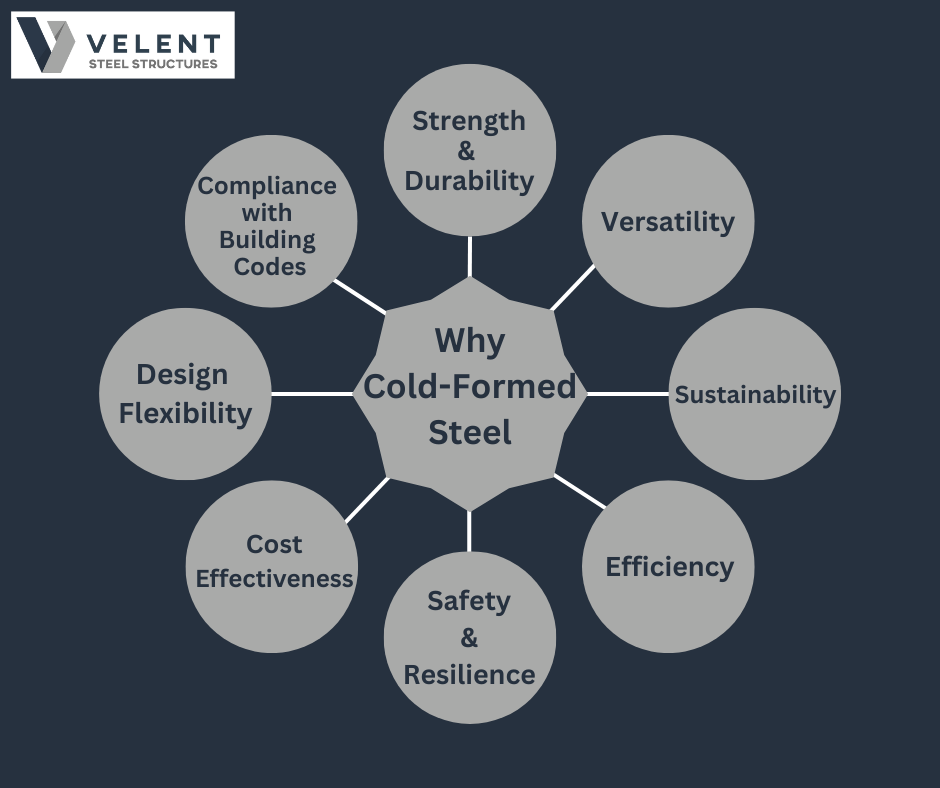
Why Cold‑Formed Steel Owns the Off‑Site Sweet Spot
- Precision + BIM – CNC roll‑formers read directly from Revit / Tekla, stamping and labelling every stud for error‑free assembly.
- Circular Economy – 100% recyclable, no loss of performance after multiple loops; each tonne of recycled steel saves 1.5 t CO₂.
- Lightweight Strength – Roughly half the weight of timber, slashing transport runs and foundation sizes.
- Environmental Resilience – Non‑combustible, mold and pest‑proof, plus excellent seismic behavior thanks to ductility.
- On‑Site Productivity – CFS frames arrive pre‑punched for services; crews need only tek‑screws and impact drivers. Douglass Colony reports up to 75% field‑time savings.
Tech Accelerators You Can’t Ignore
- Factory Automation – CAD2FAB‑driven cells retrofit wall, floor and truss lines, cutting labor bottlenecks in North America’s housing boom.
- AI & IoT – Predictive maintenance, real‑time dimensional checks and automated NCR reporting are pushing defect‑free rates > 99%.
- XR for Stakeholder Buy‑In – VR/AR walk‑throughs reduce late design changes; many lenders now demand a digital twin before releasing funds.
Proof‑of‑Concept Projects
- Cal Poly Mega‑Dorms (California, USA) – 4,200 volumetric modules; 25% cheaper and 30% faster than stick build, delivering critical student beds by 2030.
- The Fells (Brisbane, Australia) – Seven‑storey steel frame erected in 11 days; total schedule cut from 16 to 8 months using digitized off‑site fabrication.
- Braunschweig Study Pavilion (Germany) – EU Mies Award winner assembled from a demountable CFS kit, proving circular design at scale.
Decision Matrix—When to Choose What
| Question | Lean Toward Prefab Panels | Lean Toward Volumetric Modules |
| Is the building highly repetitive? | Partly | Yes |
| Are finishes high‑end or varied? | Yes | Limited palette |
| Is transport distance & route restrictive? | Yes | Limited |
| Is the schedule ultra‑compressed? | Good | Best |
| Is multi‑trade integration (MEP, FF&E) complex? | Could be | Simplifies drastically |
How Steel Manufacturers & Fabricators Can Win
- Front‑Load Design – Embed your detailers in the architect’s BIM model; every clash you resolve in Revit saves days on site.
- Certify to ICC/MBI 1200/1205 – It signals regulators that your factory processes are inspection‑ready.
- Design for Freight – Optimize module widths to standard 2.9m trailers or consider collapsible CFS pods for last‑mile constraints.
- Measure Embodied Carbon – Offer EPDs and explore CCUS partnerships (e.g., U.S. Steel’s 50kt CO₂ capture at Gary Works starting 2026).
- Stay Ahead on Green Steel – Track HYBRIT, Arvedi ESP and hydrogen DRI; early adoption can future‑proof your product line.
What’s Next (2025‑2030)
- Hybrid Systems – Steel + mass timber to hit aggressive embodied‑carbon targets.
- Distributed Micro‑Factories – Smaller CFS lines inside logistics parks to cut delivery miles.
- Carbon‑Smart Procurement – Governments weigh bids by kg CO₂ e per m², not just by cost.
- Adaptive Re‑Use – Modules designed for de‑stacking and redeployment after a 20‑year lease cycle.
Key Take‑Away
Off‑site construction is no longer an either‑or choice; it’s a spectrum. Cold‑formed steel’s precision, recyclability and code compliance place it squarely at the center of that spectrum. Whether you’re delivering flat‑pack panels or turnkey volumetric rooms, the winners in 2025 are those who lock in digital workflows, embrace the evolving standards and market the carbon‑positive narrative of modern steel.
Ready to convert concepts into CNC‑ready framing files? Talk to our team about integrating CFS into your next off‑site project.